
Montmorency Projected Release Starting Point
The first question is where the person is held and why. Montmorency County inmates are physically housed at Alpena County Correctional Facility. A local pretrial case, a county-jail sentence, and a commitment to the Michigan Department of Corrections do not use one calendar. The Alpena release log controls the time someone leaves that facility. OTIS supplies sentence and parole fields for a state prisoner. A court docket explains the order or sentence but does not prove when release processing finished.
A pretrial detainee has no sentence-based projected release date. Release may depend on bond or recognizance, dismissal, acquittal, a later sentence, or another court order. Other holds must also clear. Alpena’s published “NO BOND” explanation may mean that a bond amount has not yet reached the facility or that bond was denied. That temporary label is not a forecast. When the case results in a county sentence, the judgment, credit for time served, applicable good time, behavior, holds, and Alpena’s calculation must be read together.
The Montmorency County release-record search separates current custody, community release, and transfer when a date alone does not answer the question.
Find Montmorency Projected Release Dates
Use the source that owns the sentence. A Montmorency county-jail term is served at Alpena under the current intercounty arrangement. Contact Alpena Corrections for its calculated release or discharge date and ask the Montmorency court for the judgment and jail-credit terms. If the person entered state prison, search the Michigan OTIS offender system by MDOC number when possible. A name search requires careful comparison of identity, court, county, sentence, and status.
- Identify county pretrial custody, a county-jail sentence, or an MDOC prison sentence.
- For pretrial custody, read the court docket for bond or release orders and ask Alpena about holds and processing.
- For a county sentence, obtain the judgment, days served credit, and Alpena’s current calculation.
- For an MDOC sentence, open OTIS and confirm the MDOC number, Montmorency case, status, and sentence.
- Read Earliest Release Date, Parole Board Jurisdiction Date, Date Paroled, and Maximum Discharge Date by their official meanings.
- Confirm an actual release through the responsible facility or corrections record instead of treating an estimate as final.
Michigan’s official OTIS About page defines the date fields and explains record scope. The captured view below preserves that source context.
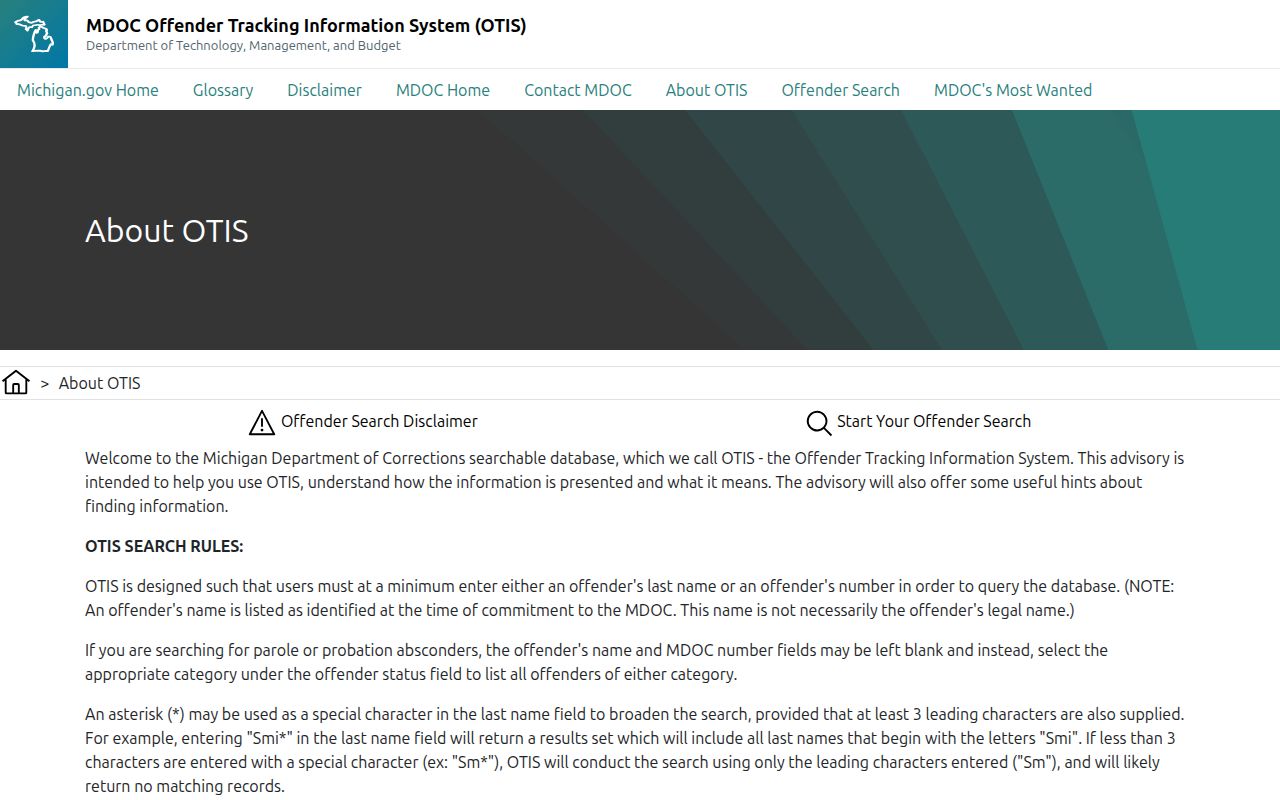
The live OTIS record should always be read with those definitions because a field label can sound more certain than Michigan law makes it.
Montmorency OTIS Release Date Fields
OTIS does not promise one universal projected release date. It uses separate fields for eligibility, actual parole, and the outside sentence boundary. The Parole Board Jurisdiction Date, also presented as an Earliest Release Date in relevant records, marks when the Board can acquire jurisdiction under the sentence and credit rules. It is not an appointment to leave prison. A date can pass after denial or deferral without any database error.
| Michigan field | Meaning | What it does not prove |
|---|---|---|
| Earliest Release Date / Board Jurisdiction Date | Possible parole eligibility threshold | That release was granted or occurred |
| Date Paroled | Date the person actually left prison on parole | That parole supervision later ended |
| Maximum Discharge Date | Potential outside sentence date as calculated | That the person stayed in prison until that date |
| DISCHRG status | No longer under MDOC jurisdiction for the shown sentence | The single path by which jurisdiction ended |
| Alpena release log date and time | Physical exit from the county holding facility | That the exit was community release instead of transfer |
Discharge can follow completed parole or probation, maximum-date discharge without parole, or death, according to the official explanation. The sentence and dates identify the path. For release notifications about a future custody event, the Montmorency County VINELink inmate search can supplement the official record, but an alert is not the sentence calculation.
Note: An Earliest Release Date is a legal threshold; Date Paroled is the direct historical field for leaving prison on parole.
Montmorency Release Is Not 85 Percent
Michigan release law should not be reduced to a generic “serve 85 percent” formula. Modern prisoners subject to disciplinary time generally must reach the judicial minimum before Parole Board jurisdiction. MCL 791.234 governs key parole eligibility and jurisdiction rules, while MCL 800.34 defines disciplinary-time prisoners by offense and date. The framework covers listed serious or life offenses committed on or after December 15, 1998, and other covered crimes committed on or after December 15, 2000. Disciplinary time for misconduct is considered in parole decision-making and may be reduced for exemplary conduct as the law permits. It is not a flat percentage credit. Parole remains discretionary unless a specific rule says otherwise. The Board may deny or defer action even after the minimum threshold. Consecutive minimum sentences can aggregate, changing the date at which the Board gains jurisdiction.
Older or otherwise credit-eligible sentences can follow legacy rules under MCL 800.33. Good-time or disciplinary credits can affect minimum and maximum calculations for those eligible cases. Specialized parole-eligible life sentences have separate calendar provisions and exceptions. They must not be used to estimate an ordinary indeterminate sentence. Sentence dates also interact with consecutive terms. When minimum terms run consecutively, they may be combined before the Board acquires jurisdiction. A court amendment, corrected credit, or later sentence can therefore change the public calculation without any promise having been broken. The correct task is to identify the law and sentence entries applied to that person, then read the resulting OTIS fields. Subtracting a fixed percentage from a judge’s minimum ignores those case-specific rules and Michigan’s discretionary parole process.
The statutory parole context is captured from Michigan’s parole eligibility law.
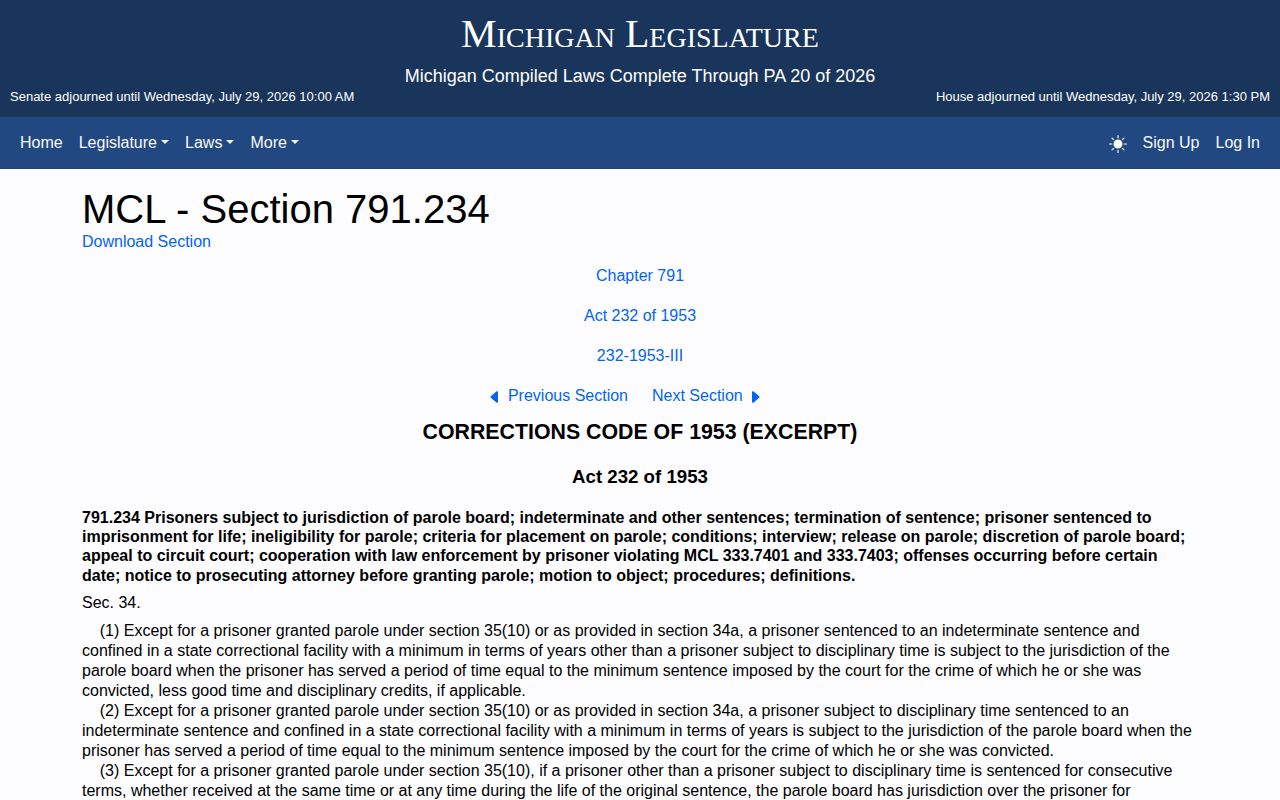
This source shows why the judicial minimum, Board authority, and sentence class must be checked before any date is described as likely release.
Montmorency County Release Good Time
A Montmorency county-jail sentence uses a separate calculation from MDOC prison timing. The sentence is physically served at Alpena County Correctional Facility. MCL 51.282 governs county-jail good time where applicable. The real calculation depends on the sentence, credit for time served, behavior, court orders, other holds, and the facility record. The number of days in the judgment is only the starting point.
Ask the Montmorency court for the judgment and any jail-credit terms. Then ask Alpena Corrections for the current calculated discharge or release date. If another warrant, detainer, or sentence exists, the end of one local term may lead to transfer instead of community release. Court changes can also alter the date. The facility must process identity, orders, property, and receiving-agency issues before physical departure.
- Time served
- Credit for qualifying time already spent in custody as applied by the court and law.
- Good time
- A county-jail credit governed by the applicable statute and facility record, not the MDOC parole framework.
- Detainer
- A notice or hold from another authority that can prevent community release.
- Remand
- A court direction returning or committing a person to custody.
Note: County good time cannot safely be calculated from the sentence length alone; use the court terms and Alpena’s current record.
Why Montmorency Release Dates Change
A projected date can move because the underlying legal or correctional facts change. Some changes affect eligibility. Others block the actual handoff after one sentence ends. Still others correct the public data without creating a new order. The cause should be identified before interpreting the new date.
| Event | Effect on projected or actual release |
|---|---|
| Court corrects judgment or jail credit | Changes the legal sentence calculation |
| Consecutive sentence is identified | Minimum and maximum terms may aggregate |
| Parole Board denies or defers | Eligibility date passes without actual release |
| Misconduct or disciplinary-time consequence | Affects consideration under the governing framework |
| New warrant, detainer, or case | Can prevent community release when another term ends |
| Bond modification | Changes pretrial release eligibility |
| Transfer to MDOC | Ends county location but starts state custody |
| Data correction | Changes a public field without a new legal release |
A release order can also precede physical exit. Paperwork, identity checks, property return, transport, or another hold may take time. The court explains authority. The release log establishes when the facility completed the event.
Montmorency’s two-county custody path makes that distinction more important. The Montmorency docket may show the order that changed legal authority, while Alpena records the physical exit. If Alpena transfers the person to MDOC, the local roster can change before OTIS displays the new state location. That sequence is a custody handoff, not an actual community release. Keep the time and source of each event separate.
Confirm Montmorency Actual Release Dates
Actual release must be confirmed from the system that held the person. For a Montmorency county detainee, ask Alpena for the release date and time, release reason, and destination. A transfer destination matters because departure from Alpena can lead to MDOC, another county, or federal custody rather than the community. Match the booking number and Montmorency case number whenever possible.
For a state prisoner, Date Paroled is stronger evidence of actual prison departure than the earliest eligibility date. DISCHRG means MDOC jurisdiction shown for the sentence ended, but the details explain how. A future maximum date is the outside sentence endpoint as calculated, not a promised parole date. For a pretrial case, use the court order and the Alpena physical release event. No one field answers all three paths.
Keep the source date with the answer because calculations and public fields can change. The most useful record notes the system, identifier, field name, and when it was checked.