
Montmorency Parole and Probation Basics
Parole and probation can both require reporting, travel limits, and compliance with case-specific rules, but they begin in different ways. Parole is release from a Michigan Department of Corrections prison sentence into the community while MDOC jurisdiction continues. The Michigan Parole Board decides whether an eligible prisoner will be paroled. Probation is imposed by a court as a sentence or disposition. MDOC may supervise a probationer, yet Michigan describes that person as remaining under circuit or county jurisdiction. For Montmorency County, the court record must therefore be read with the supervision record.
A person released from the Alpena County Correctional Facility after a Montmorency arrest is not automatically on parole. Alpena is the county facility that physically houses Montmorency detainees. A bond release, time-served release, or dismissal may have no parole component. A commitment from the 26th Circuit Court to MDOC starts a state-prison path. If that prisoner later leaves prison on parole, the state record is the key source. The full Montmorency release trail can be checked through the Montmorency County released-inmate search path.
| Point | Parole | Probation |
|---|---|---|
| How it begins | Release from an MDOC prison sentence | Court sentence or case disposition |
| Decision source | Michigan Parole Board | Sentencing court |
| Main public check | OTIS parole status and Date Paroled | OTIS when MDOC supervises, plus the Montmorency docket |
| Ending status | Discharge from MDOC jurisdiction | Completion or discharge under the governing court and agency record |
These labels describe legal status, not where the person lives. An OTIS location for someone under supervision can refer to an office or supervision assignment. It should not be treated as a home address.
- Parole
- Community release from prison while MDOC supervision and sentence jurisdiction continue.
- Probation
- A court-ordered form of supervision that may be used instead of, or after, a local custody term.
- Discharge
- The end of the correctional jurisdiction shown for the sentence, subject to the exact record.
- Absconder
- A supervision status indicating failure to remain in required contact, not an ordinary completed discharge.
Verify Montmorency Post-Release Supervision
The official Michigan OTIS search is the main public check for a Montmorency person who entered MDOC custody or is under state supervision. Its status choices include Active, All, Prisoners, Parolees, Probationers, Discharged, Parole Absconders, and Probation Absconders. A last name or MDOC number is required. The system also permits first name, sex, race, age, and identifying-mark filters. Use the MDOC number when known because it takes priority and is more reliable than a common name.
Verification means matching the person and then interpreting status. It is not enough to see one familiar name. Compare the MDOC number, age or birth information as shown, court and county, sentence entries, and available identity details. A Montmorency probation case should also be checked in the 26th Circuit record. A county-only misdemeanor or local jail episode may have no OTIS record at all.
- Open OTIS and select Parolees, Probationers, Discharged, an absconder filter, or All based on the known facts.
- Enter the MDOC number when available. Otherwise use the name and narrow the results with supported details.
- Open the detail record and confirm the person through several identifiers, not a photograph alone.
- Read status, location, court, county, sentence, Date Paroled, and discharge information together.
- Use the MDOC parole and probation office locator to identify the current supervising office.
- For probation, compare the state entry with the Montmorency court docket and contact the office shown by the record.
The official MDOC office directory shows how current supervision contacts are found. The MDOC parole and probation page is shown in the captured view below.
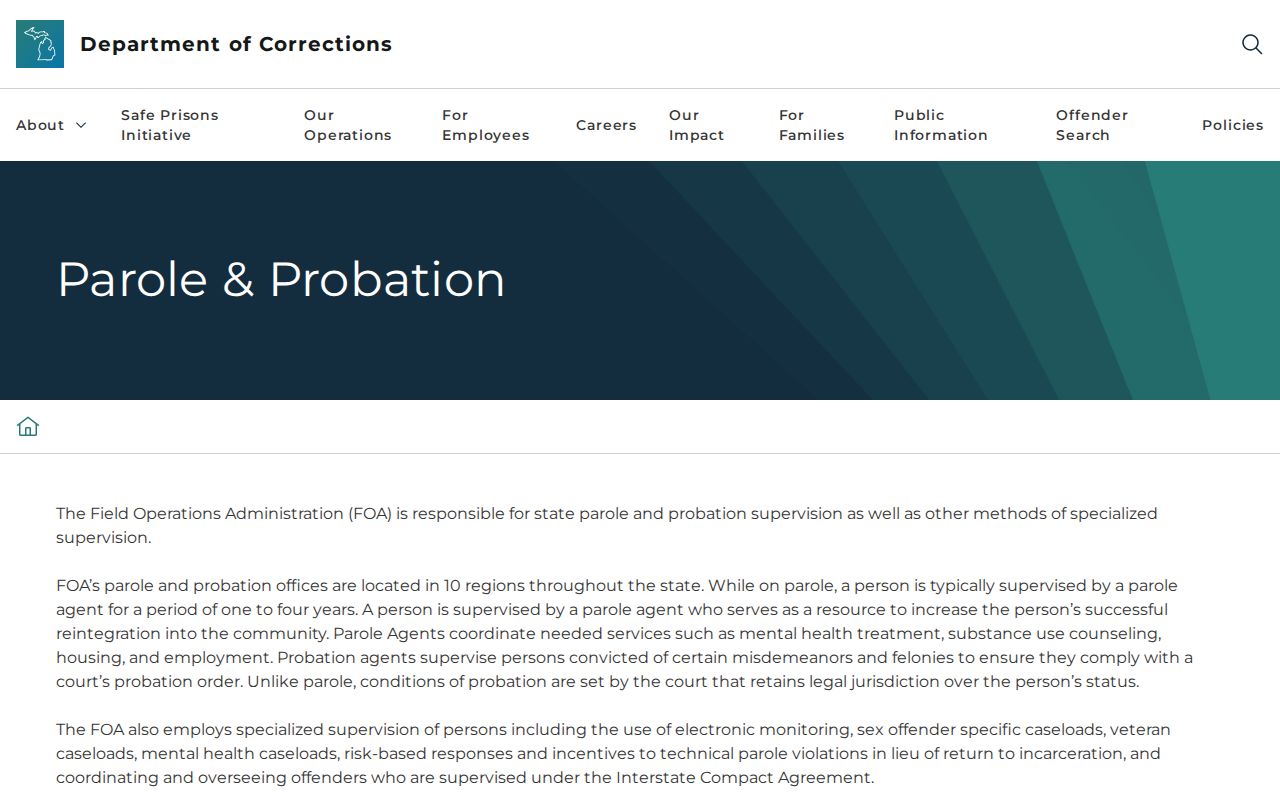
Use the live directory because office assignments can change, and do not assume the closest building has the case.
Read Montmorency OTIS Supervision Fields
OTIS fields have precise roles. The status tells whether the record shows prison, parole, probation, discharge, or another correctional state. The location changes meaning with that status. For a confined prisoner it can identify a facility. For a parolee or probationer it can point to supervision. For an absconder it is the last supervision location and is not a live location for the person.
| OTIS item | How to read it |
|---|---|
| MDOC number | The strongest public identifier for the state correctional record |
| Date Paroled | The date the offender actually left prison on parole |
| Parole Board Jurisdiction Date | An eligibility threshold, not proof that release occurred |
| Location | A facility or supervision location depending on status |
| DISCHRG | No longer under MDOC jurisdiction for the displayed sentence |
Discharged does not always mean successful completion of parole. MDOC explains that the category can include completion of parole or probation, maximum-date discharge without parole, or death. Sentence context matters. OTIS also states that records generally remain public for three years after discharge and may then disappear. A set-aside can also affect public access. An absent older record does not prove that no state supervision existed.
Note: Date Paroled proves departure from prison on parole; it does not prove that the later supervision term has ended.
Montmorency Parole Absconders and Warrants
An absconder label is a warning that ordinary supervision has been disrupted. It is not a discharge and should not be read as proof of a new community release. Michigan directs users to distinct parole-absconder and probation-absconder filters. MDOC actively seeks parole absconders, while information about a probation absconder is routed to the sheriff in the sentencing county. No separate official Montmorency County online absconder or warrant list was found in the research sweep.
The OTIS Most Wanted and absconder page is useful, but it is not a complete list of every Montmorency warrant. Its captured screen documents the statewide route.
Read the last supervision location only as an administrative field. It does not show a current street location, and it does not establish where the person stopped reporting.
Montmorency Supervision Office Routing
Michigan supervision assignments must be found from the live MDOC directory or the specific record. The research did not verify one fixed field-office address for every Montmorency parolee or probationer. That gap should not be filled by guessing. Give the office the MDOC number and ask for the current office permitted to discuss the supervision record. OTIS help material lists a general assistance number, while district and circuit probation questions follow the court shown in the case.
Michigan Department of Corrections
Field Operations Administration, Parole and Probation
Office route: Official office locator
OTIS assistance: 517-335-1426
For a Montmorency district matter, the official 88th District Court page identifies criminal and district probation functions. A circuit case should be routed through the 26th Circuit record and the MDOC or court arrangement it names. Court staff can explain public filing access, but they do not replace the supervising officer.
Montmorency Post-Release Mental Health Support
Montmorency County has no verified branded reentry office in the source review. A specific regional support route does exist. The sheriff links Northeast Michigan Community Mental Health, which serves Montmorency, Alpena, Alcona, and Presque Isle counties. Its Hillman contact can help with behavioral-health and crisis navigation after release. It cannot confirm release, parole, probation, or the terms of a court order.
Northeast Michigan Community Mental Health
630 Caring Street
Hillman, MI 49746
Local: 989-742-4549
Crisis: 989-356-2161 or 800-968-1964
This distinction matters. Support services address health and stability, while MDOC and the court control supervision facts. A person should use the agency named in the order for reporting questions and use the regional provider for care navigation.
How Montmorency Supervision Ends
Supervision ends through the legal process that governs the sentence, not through disappearance from a search result. A parolee remains under MDOC jurisdiction until discharge. A probationer follows the court and agency terms in that case. OTIS may later display DISCHRG, but the meaning must be checked against the sentence and dates. A maximum-date discharge without parole differs from completed community parole, and both differ from an absconder entry.
For an older Montmorency County record, combine the court docket, permitted MDOC records, and the supervising office. Public OTIS retention is not permanent. The Michigan Freedom of Information Act can govern requests to executive agencies, while court files follow judicial access rules. The release record and supervision record should be kept separate: one proves departure from custody; the other shows the legal status that follows.
Case closure is also different from supervision discharge. A docket may show the sentence and later orders, while MDOC keeps the operational supervision entry. When the two sources seem to conflict, compare the case number, MDOC number, dates, and exact status language. Then ask the office named by the current record which public document confirms the end of Montmorency County supervision.
Note: A final discharge should be verified from the sentence-specific agency or court record, especially when the public OTIS entry is gone.