
Federal Prison Release Scope
The Federal Bureau of Prisons operates the national prison system for covered federal inmates. No federal prison in Montmorency County was identified in the reviewed official directories. The system still matters when a person with a Montmorency connection was prosecuted federally, sentenced to BOP custody, or later moved through a federal institution elsewhere. The Montmorency County Sheriff custody statement identifies Alpena as the local serving jail before any supported federal handoff.
Local custody does not become federal merely because a federal agency is mentioned. A person can leave Alpena County Correctional Facility for U.S. Marshals Service transport and remain detained. BOP generally becomes the locator for sentenced federal custody. The county release entry or federal docket should supply a factual bridge before a BOP search is treated as relevant.
Search Federal Prison Releases
Use the official BOP Inmate Locator. The strongest search uses a BOP register number or another accepted federal identifier. A name search can be narrowed with race, sex, and age, but those fields must still be compared with known case facts. Similar names and spelling variants can return the wrong person.
- Choose the number search when a BOP, DCDC, FBI, or INS number is known.
- Otherwise enter the first and last name, then add only reliable identifying details.
- Compare the result with the federal docket, event dates, and known custody history.
- Read the location and release-date fields together.
- If the result says Released or shows a past date without a facility, treat it as departure from BOP custody only.
- Check the appropriate state, local, immigration, or supervision source when another authority may apply.
The Montmorency County release search starts with the custody system so BOP is not used in place of the Alpena booking record or Michigan OTIS.
Federal Prison Release Results
The BOP explanation of federal inmate records states that a past release date with no facility means the person was released on that date and is no longer in BOP custody. A location of “RELEASED” carries the same core meaning. Current wording can also say the person is not in BOP custody.
| BOP display | Meaning | Limit |
|---|---|---|
| Past Release Date | Departure from BOP custody on the date shown | Does not clear other authorities |
| RELEASED | No longer held by BOP | Supervised release may still apply |
| Future date | Projected federal release information | May change |
| UNKNOWN | The term has not been determined | Not a release forecast |
| IN TRANSIT | Movement within federal custody | Not community release |
BOP itself cautions that another correctional or criminal-justice system may still hold authority. A federal release can also be followed by federal supervised release. The public result answers a limited custody question, not every legal status that may remain.
Note: A BOP release date should be reported as release from BOP, not as proof of freedom from all custody or supervision.
Federal Release Record Coverage
The public BOP locator includes federal inmates released after 1982. That coverage line helps explain why an older federal case may not return a public result. Earlier records can be sought from the National Archives using the person’s name, date of birth or approximate age, race, approximate incarceration dates, and institution when known.
A future release date is projected and may change. A court ruling, sentence calculation, credit, new matter, or custody change can affect what occurs. When an exact release document is needed, the public locator result should be used as a lead to the correct BOP or archival record, not copied as though it were a certified order. The federal judgment remains a court record and may describe supervised release that begins after imprisonment.
Locator appearance does not by itself prove a conviction. The federal dataset can include people held before trial, cases with dismissed charges, material witnesses, and civil-contempt custody. Use the federal docket to identify the legal basis, sentence, and release order. PACER is the federal court access route in the research, while the clerk may provide the appropriate record method for a particular case.
- BOP custody
- Custody administered by the Federal Bureau of Prisons.
- Supervised release
- A federal court-ordered period in the community after imprisonment.
- In transit
- Movement within federal custody, not a release to the community.
Montmorency Federal Release Trail
A federal inquiry with a Montmorency County starting point can cross several custodians. The Montmorency Sheriff Records Department may hold an arrest, warrant-service, or transport record. Alpena Corrections holds the physical booking and exit record for a county detainee held there. USMS can take custody for federal court, and BOP can later hold a sentenced federal prisoner. Each event has its own date and meaning.
Ask Alpena for the destination or receiving agency when the person vanished from the current roster after a suspected federal handoff. Check the Montmorency court trail for the local outcome, then check the federal docket for a detention or release order. If BOP later shows Released, that is a separate federal departure. Do not backdate it to the earlier Alpena transfer or call the county roster exit a BOP release.
The same care applies when more than one case exists. A person may finish a BOP term while a state warrant, local case, immigration action, or another sentence remains. BOP expressly warns that another justice system can still apply. Describe the named system and date, then check the other authority only when the record trail provides a factual reason.
Does a federal release result confirm an Alpena release? It confirms only the BOP event. Alpena’s release or transfer record is needed for the earlier county-facility exit.
Federal Release Field Guide
The official BOP records explanation gives the controlling meanings and coverage limits for locator results.
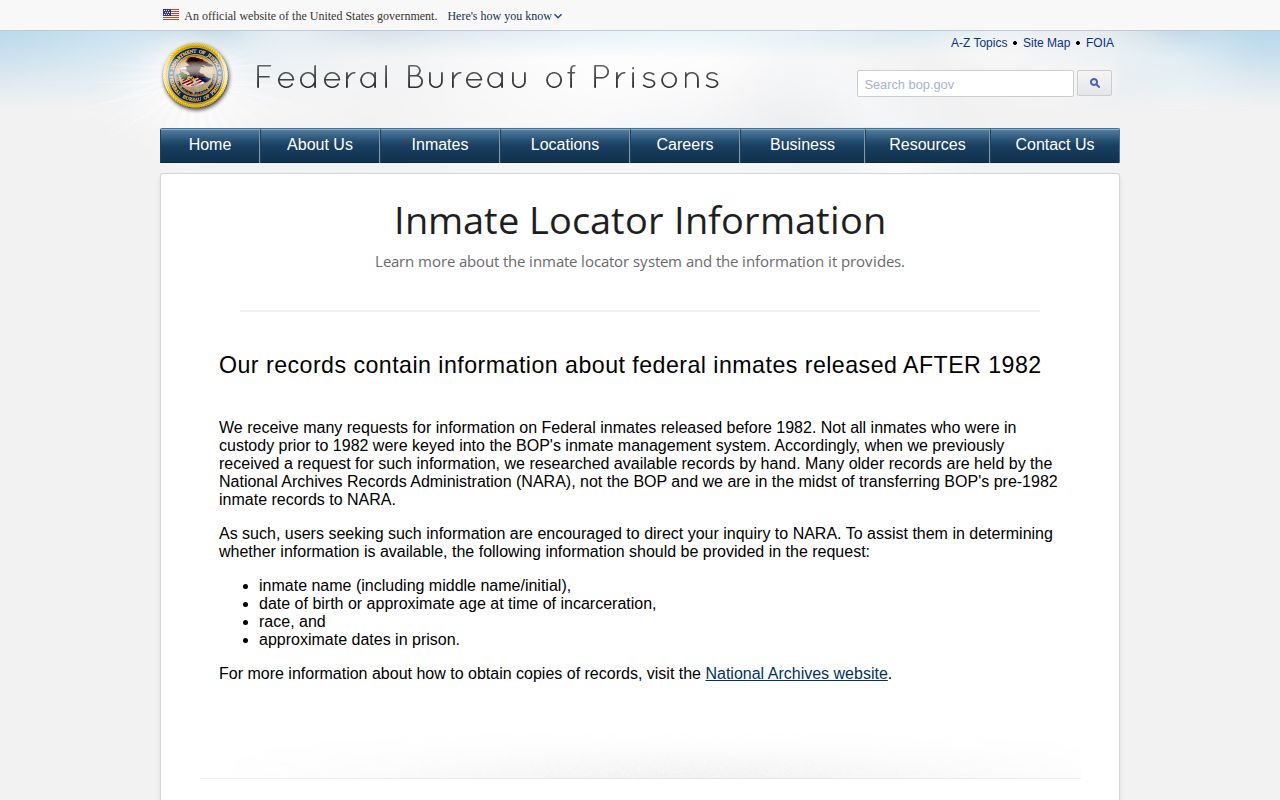
The explanation is essential when a result says Released, Unknown, or In Transit because those terms describe distinct federal custody states.
Federal Prison Release Records
The BOP locator is a public index, not a certified release document. When the exact federal record is required, identify the register number, federal case, institution, and date range before asking the proper agency. A sentence and judgment come from the federal court. A BOP custody record comes from BOP. A pretrial transport or detention record may belong to USMS.
USMS publishes no historical released-person locator comparable to BOP. Its official custody overview explains its role, while its FOIA channel handles permitted agency-record requests. A court order can show legal authorization, but the custodian’s record should still be used for the physical movement or release when that distinction matters.
A useful request identifies the full name, federal register number, case number, approximate custody dates, and institution or transport event. Ask the agency for a defined record rather than a general conclusion. Privacy rules and exemptions can limit what is released to a third party. For a person’s own permitted records, follow the identity and authorization requirements published by the agency.
Federal Bureau of PrisonsNational inmate system
Public locator: bop.gov/inmateloc/
Records coverage guidance: bop.gov/inmateloc/about_records.jsp
Federal Release Search Limits
Do not use BOP for a Montmorency county-only arrest, an Alpena jail sentence, or an MDOC prison term. Those belong to Alpena, the Montmorency courts, or OTIS. ICE custody is also separate. A no-result in the BOP locator cannot prove that a person was released from ICE, USMS, state, or county authority.
VINE is not a substitute for the federal locator either. Michigan VINE can report events from participating state and local agencies, while BOP maintains its own federal records. If a county notification says transfer, follow the named receiving agency. If a federal court later imposes supervised release, the docket and supervising federal authority supply that legal context after the BOP prison term.
Identity matching should use the federal register number when possible, plus the full name, age or birth information, court, case number, and approximate dates. Once the correct person is established, describe only what the BOP result supports. “Released from BOP custody” is precise. “Released from all custody” requires checks beyond this system.