
Montmorency Sheriff Release Role
The official jail-information page states that Montmorency County inmates are housed at Alpena County Correctional Facility. This is more reliable than an old map or directory that places a combined “sheriff/jail” label at the Atlanta address. The Sheriff’s Office remains the local law-enforcement and records agency, but the research does not represent the building as a separately verified public jail.
That distinction decides which office can answer each question. Montmorency may document an arrest, warrant service, local transport, incident, or paperwork created by its deputies. Alpena holds the booking, current roster entry, physical release time, property processing, and receiving destination. A complete inquiry may require both files. One describes how custody began locally; the other records how the confinement episode ended.
Confirm Montmorency County Release
A person can leave the Alpena roster for reasons that do not amount to community release. The next step may be bond-out, sentence completion, dismissal, transfer to MDOC, movement to another jail, or delivery to a federal authority. The Montmorency Sheriff can help identify locally held paperwork, but Alpena must confirm whether the person physically left its facility and what destination was entered.
- Check the official Alpena current-inmate wrapper to see whether the person remains listed.
- Call Alpena Corrections with the exact name, date of birth if known, and approximate booking date.
- Ask whether the exit was release to the community or transfer to another custodian.
- Search both Montmorency court portals for the bond, disposition, sentence, probation, or commitment order.
- Request the Alpena release entry and the Montmorency-created arrest or transport record when documentary proof is needed.
The Montmorency County released inmate lookup explains how those sources fit together. The core rule is simple: no single missing name proves release.
Note: A court order supplies legal authority, while the Alpena release log supplies the physical exit time and destination.
Montmorency Sheriff Release Requests
The Montmorency Sheriff FOIA page directs written requests to the Records Department. A focused request should identify the exact person, a narrow date range, the arresting event, and any known case or booking number. Ask for named records instead of asking the office to research an open-ended history.
Montmorency County Sheriff’s OfficeATTN: Records Department
11045 M-32 West
Atlanta, MI 49709
Phone: 989-785-4238
Fax: 989-785-4471
The sheriff page accepts pickup or drop-off at the office and requests by fax. It also links a downloadable form. Fees depend on the requested information; no fixed local price is published for a release record or booking photo. Michigan FOIA requires the public body to respond within the statutory business-day framework by granting, denying, partly granting, or using the permitted written extension.
Michigan FOIA, MCL 15.231 and the sections that follow, governs executive-agency requests. The response period is five business days, with one permitted written extension of up to ten business days. Allowable charges can include actual incremental labor, copying, and mailing under the public body’s procedures. A response can also cite privacy, active-investigation, or security grounds for withholding part of a record. None of those rules turns a court judgment into a sheriff FOIA record; judicial files remain with the clerk.
Montmorency Sheriff Record Types
The Montmorency County Sheriff’s Office may possess records that Alpena did not create. Ask only for items tied to the local event and let the Records Department determine what it holds and what can be disclosed. If a record is partly exempt, a request can seek the reasonably segregable public portions with protected details redacted.
| Requested record | What it may show | Likely next source |
|---|---|---|
| Incident or arrest report | Local event and arresting agency | Matching court docket |
| Warrant-service record | Authority used to take custody | Issuing court |
| Transport record | Movement from Montmorency to the serving jail | Alpena booking entry |
| Locally held release paperwork | An order or document received by the sheriff | Alpena physical release log |
| Booking photo, if possessed | An image held in official work | Alpena booking custodian |
Montmorency may not have the physical jail-management fields merely because the arrest started in the county. If the requested item belongs to Alpena’s booking system, ask where Alpena accepts a written FOIA request rather than treating a Montmorency response as the last word.
Montmorency Release Court Trail
The official Montmorency case-search page routes users to separate 88th District and 26th Circuit searches. A misdemeanor stays within the district-court path. A felony can start with district preliminary events and continue to a circuit judgment. Search both when the charge level or final court is not clear.
Useful entries include arraignment, bond type and amount, a release order, dismissal, plea or verdict, jail credit, judgment of sentence, MDOC commitment, probation, violation, and discharge. Those entries explain the legal basis for custody changes. They do not provide the exact moment Alpena completed processing. “Case closed” also does not establish that no other warrant, sentence, or hold existed.
The official 88th District page lists its Atlanta court address, public telephone, fax, and weekday hours. Those details help route a request for the public register of actions, bond order, judgment, commitment document, or probation-discharge entry. Circuit files should be requested through the 26th Circuit route. When the statewide interface applies its seven-year sentence filter, contact the court rather than treating an absent older case as proof that no record exists.
- Bond order
- Court authority for conditional pretrial release after the facility completes its checks.
- Commitment
- An order sending a person into another custody system, often MDOC, rather than into the community.
- Discharge
- Completion of the legal status defined by the relevant court or corrections system.
Note: MiCOURT’s public display limits do not establish that an older court file or sheriff record was destroyed.
Montmorency Sheriff Custody Source
The official Montmorency Sheriff site is the starting point for the county’s current agency identity and local records route.
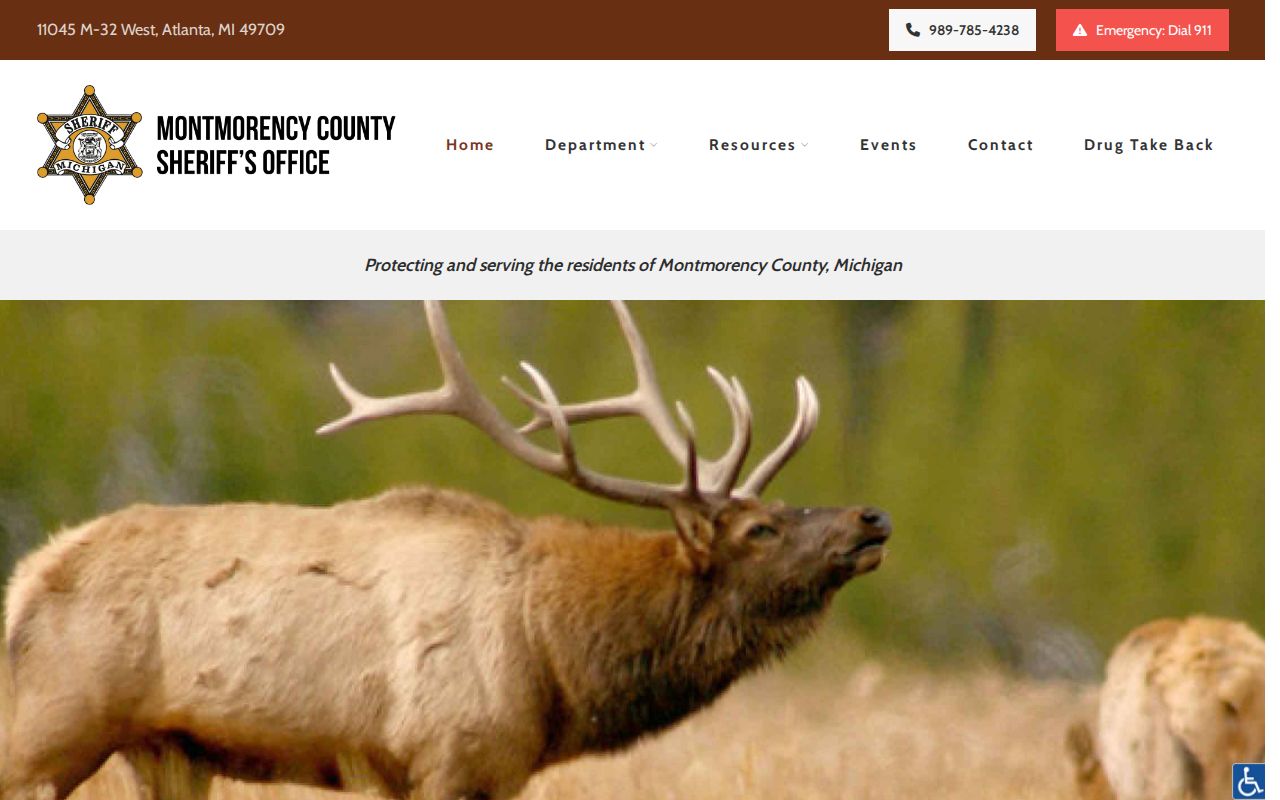
The official jail statement on that site directs the physical-custody side of a released-person inquiry to Alpena rather than an assumed Atlanta jail.
Montmorency Release Destinations
A release record needs a destination. Community release may follow bond, recognizance, completion of a county sentence, dismissal, or another controlling order. Transfer to MDOC means county custody ended but state imprisonment began. Movement to another county, USMS, or ICE likewise means the person stayed in government custody.
Use OTIS only when the court or jail trail supports MDOC custody. Use BOP only for a federal identity or federal sentence. ICE’s online locator covers current immigration detention, not a past community-release history. When no public locator fits, the receiving-agency field in Alpena’s record and the Montmorency court document provide the best bridge to the next custodian.
Limits of Montmorency Release Records
A public record can be redacted or withheld in part under an applicable Michigan FOIA exemption. Juvenile, sealed, set-aside, investigative, privacy, and custodial-security issues may limit disclosure. The fact that a current online interface no longer shows an item is not a retention rule. Different record series follow different schedules.
Michigan calls expungement a conviction set-aside. A set-aside can restrict ordinary public access while a nonpublic state record remains for the uses allowed by law. Sheriff, court, jail, and MDOC systems do not all follow the same public display or retention rules. That is why a missing MiCOURT or OTIS entry should not be used to contradict an identified Alpena booking without checking the proper custodian.
Identity also requires care. Compare full name, spelling variants, date of birth or age, case number, booking number, arresting agency, and event date. A photograph should support a match, not replace those identifiers. Once the correct Montmorency event is found, connect it to the Alpena booking and the proper court docket before deciding that the person entered the community.
The county’s official social presence and events page may publish agency news, but neither was verified as a systematic release list. No official Montmorency or Alpena inmate app was found. Use those channels only for the specific item they publish, never as a complete jail-status or released-person archive.